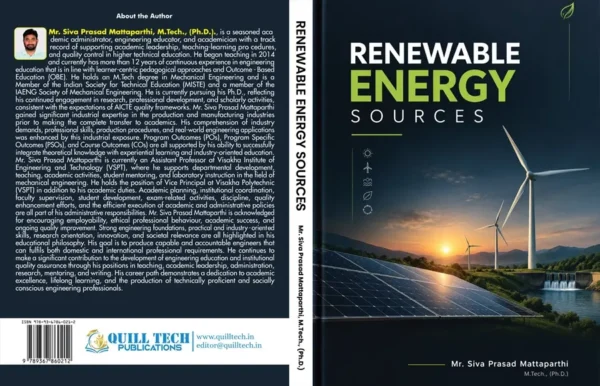
Renewable Energy Sources is a comprehensive academic and professional resource that provides a systematic study of renewable energy technologies, their operating principles, applications, advantages, limitations, and future prospects. The book covers major renewable energy resources including solar, wind, biomass, hydropower, geothermal, ocean, wave, and tidal energy, along with emerging chemical energy technologies such as fuel cells and hydrogen energy. It presents detailed coverage of solar radiation, photovoltaic cell equivalent circuits, I–V and P–V characteristics, solar energy collectors, storage systems, and practical applications including solar water heating, solar ponds, greenhouses, drying, and cooking. The book also examines wind energy conversion principles, wind characteristics, power generation, site selection, system components, classifications, and applications; biomass conversion technologies, photosynthesis, biogas digestion, hydropower systems, and geothermal resources and applications; ocean thermal energy conversion, wave energy conversion devices, and tidal energy systems; and fuel cells, hydrogen production and storage, hydrogen applications, and magnetohydrodynamic power generation. In addition, it introduces renewable energy integration, energy storage, environmental considerations, economic aspects, and challenges associated with sustainable energy development. Designed for students, educators, researchers, engineers, and energy professionals, the book combines fundamental concepts with technological and practical perspectives to support a clear understanding of renewable energy systems and their role in developing reliable, sustainable, and environmentally responsible energy solutions.
About the Author
Mr. Siva Prasad Mattaparthi, M.Tech., (Ph.D.)., is a seasoned academic administrator, engineering educator, and academician with a track record of supporting academic leadership, teaching-learning procedures, and quality control in higher technical education. He began teaching in 2014 and currently has more than 12 years of continuous experience in engineering education that is in line with learner-centric pedagogical approaches and Outcome-Based Education (OBE). He holds an M.Tech degree in Mechanical Engineering and is a Member of the Indian Society for Technical Education (MISTE) and a member of the IAENG Society of Mechanical Engineering. He is currently pursuing his Ph.D., reflecting his continued engagement in research, professional development, and scholarly activities, consistent with the expectations of AICTE quality frameworks. Mr. Siva Prasad Mattaparthi gained significant industrial expertise in the production and manufacturing industries prior to making the complete transfer to academics. His comprehension of industry demands, professional skills, production procedures, and real-world engineering applications was enhanced by this industrial exposure. Program Outcomes (POs), Program Specific Outcomes (PSOs), and Course Outcomes (COs) are all supported by his ability to successfully integrate theoretical knowledge with experiential learning and industry-oriented education. Mr. Siva Prasad Mattaparthi is currently an Assistant Professor at Visakha Institute of Engineering and Technology (VSPT), where he supports departmental development, teaching, academic activities, student mentoring, and laboratory instruction in the field of mechanical engineering. He holds the position of Vice Principal at Visakha Polytechnic (VSPT) in addition to his academic duties. Academic planning, institutional coordination, faculty supervision, student development, exam-related activities, discipline, quality enhancement efforts, and the efficient execution of academic and administrative policies are all part of his administrative responsibilities. Mr. Siva Prasad Mattaparthi is acknowledged for encouraging employability, ethical professional behaviour, academic success, and ongoing quality improvement. Strong engineering foundations, practical and industry-oriented skills, research orientation, innovation, and societal relevance are all highlighted in his educational philosophy. His goal is to produce capable and accountable engineers that can fulfils both domestic and international professional requirements. He continues to make a significant contribution to the development of engineering education and institutional quality assurance through his positions in teaching, academic leadership, administration, research, mentoring, and writing. His career path demonstrates a dedication to academic excellence, lifelong learning, and the production of technically proficient and socially conscious engineering professionals.