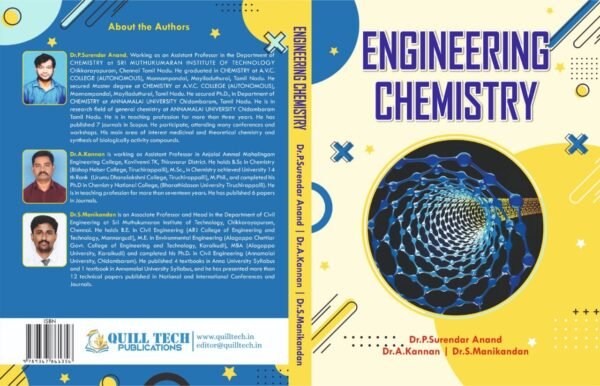
Engineering Chemistry, authored by Dr. P. Surendar Anand, Dr. A. Kannan, and Dr. S. Manikandan, is a comprehensive textbook designed to provide a deep understanding of chemistry concepts essential for engineering students. Published by Quill Tech Publications, the book covers a wide array of topics relevant to both academic and industrial applications. The book begins with a detailed exploration of Water and Its Treatment, emphasizing the importance of water quality, impurities, and purification methods such as filtration, sedimentation, and disinfection. It also covers advanced treatment methods like reverse osmosis and boiler feedwater treatment, ensuring a thorough grasp of water management in industrial settings. In the Nanochemistry section, readers are introduced to nanomaterials, including nanoparticles, nanoclusters, nanowires, and nanotubes. The authors explain their unique size-dependent properties and various preparation methods, highlighting their applications in fields like electronics, medicine, and environmental technology. The chapter on Phase Rule and Composites discusses phase diagrams and the behavior of different material phases. It also covers composite materials, their properties, and industrial uses in enhancing material strength, making it highly relevant to engineering material design. Fuels and Combustion provides insights into various types of fuels, including coal, petroleum, and biodiesel. The book explains combustion processes, fuel efficiency, and emission control methods, addressing modern environmental concerns related to fuel usage. The Energy Sources and Storage Devices chapter explores renewable and non-renewable energy sources. It discusses solar energy, wind power, and nuclear reactors, along with modern storage technologies like lithium-ion batteries, fuel cells, and supercapacitors, making it invaluable for those studying energy engineering. Each topic is supported by diagrams, examples, and exercises, making the learning experience engaging and practical. The inclusion of real-world case studies ensures that students can connect theoretical concepts to practical engineering applications. The authors emphasize sustainable engineering practices, reflecting the growing need for environmentally friendly technological solutions. This approach aligns the book with current industrial and research trends in engineering. Overall, Engineering Chemistry is a well-structured, informative, and practical guide. It is an essential reference for engineering students and professionals aiming to master the chemistry principles that underpin modern engineering and technological innovations.
Engineering Chemistry
Get more info
Authors: Dr. P. Surendar Anand, Dr. A. Kannan, Dr. S. Manikandan
ISBN: 978-93-6786-135-6
Published Date: December,2024
Edition: First
Language: English