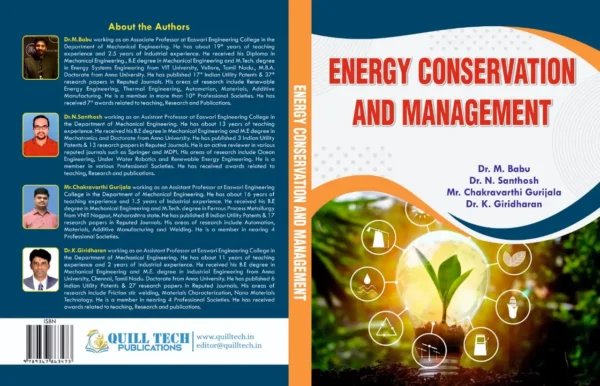
This comprehensive textbook serves as an essential guide for students, educators, and industry professionals seeking to understand the principles, practices, and applications of energy conservation and management. Authored by experienced academicians and engineers, the book emphasizes a multidisciplinary approach, integrating theoretical foundations with practical strategies across mechanical, electrical, thermal, and renewable energy domains. The opening chapter sets the stage by exploring the role of energy in economic development and delineating various forms and sources of energy categorized by origin, transaction, renewability, and conventionality. It emphasizes the critical transition from fossil fuels to renewable alternatives, highlighting global shifts toward sustainable power systems. Subsequent sections examine the evolution of global energy consumption, contrasting historical dependence on coal and oil with the rising influence of renewables. Through data-driven discussions, the book outlines national energy consumption patterns across major economies including China, the United States, India, and Germany, while contextualizing these trends in light of technological progress and climate goals. A dedicated focus is placed on the environmental implications of energy use, detailing adverse effects such as air and water pollution, greenhouse gas emissions, and land degradation. Case examples illustrate real-world consequences and underscore the urgency for eco-conscious energy strategies. The concept of energy auditing is introduced as a cornerstone of effective energy management. Detailed coverage is given to various audit types from preliminary walkthroughs to investment-grade assessments along with their methodologies, instruments, and actionable outcomes. The roles of energy managers are comprehensively mapped across strategic and operational levels. From developing energy policies to coordinating implementation and fostering awareness, the book positions energy managers as key drivers of organizational efficiency and sustainability. Electrical systems receive detailed attention in the second chapter, including billing mechanisms (HT and LT), transformer operations, power factor improvement, and harmonic management. Emphasis is placed on measurement, optimization, and modern technologies like LED lighting and capacitors. Thermal systems are treated in depth, covering stoichiometry, boiler efficiency, steam systems, cogeneration, and specific energy consumption analysis. Real-world equations and energy-saving methodologies provide readers with tools for evaluating and improving system performance. Energy conservation in utilities including fans, pumps, blowers, and HVAC systems is tackled with precision. The book identifies practical energy-saving opportunities and offers actionable guidance on implementation, aligning engineering design with operational efficiency. Economic aspects are discussed thoroughly in the final chapter. Concepts such as payback period, IRR, NPV, and life cycle costing are explained with clarity, supplemented by case studies and the ESCO model. These insights are intended to support decision-making in both public and private sector energy projects. The book culminates in presenting a unified framework that combines technical knowledge, policy alignment, financial analysis, and sustainability principles. It serves as both a foundational textbook and a practical handbook for those aiming to contribute to a cleaner, smarter energy future.
Energy Conservation and Management
Get more info
Authors: Dr. M. Babu, Dr. N. Santhosh, Mr. Chakravarthi Gurijala, Dr. K. Giridharan
ISBN: 978-93-6786-347-3
Published Date: April,2025
Edition: First
Language: English