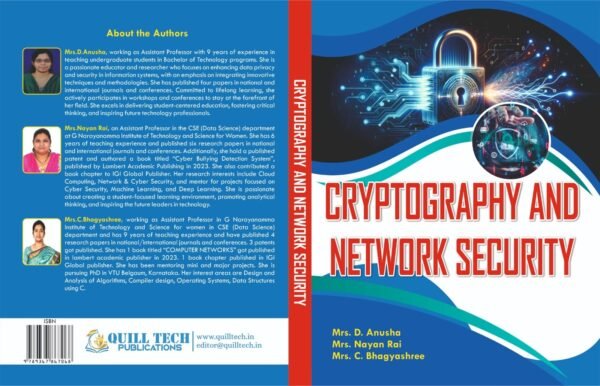
“Cryptography and Network Security” by Mrs. D. Anusha, Mrs. Nayan Rai, and Mrs. C. Bhagyashree offers a comprehensive exploration of the principles and applications of cryptography and the various facets of network security. This book is designed to equip students, educators, and professionals with a deep understanding of the essential concepts, emerging trends, and real-world challenges in the field of cybersecurity. The book begins with an introduction to the fundamentals of information security, addressing modern security trends, ethical aspects, and the growing importance of securing digital assets. It explores the need for multi-level security, highlighting threats and vulnerabilities that arise in today’s interconnected digital environments. Basic terminologies like encryption, decryption, keys, and cryptanalysis are also clearly defined. A strong foundation in classical encryption techniques is provided, covering substitution and transposition ciphers, including the Caesar cipher, Playfair cipher, and Hill cipher. The authors explain how these techniques work and discuss their strengths and limitations. Practical examples illustrate how to encrypt and decrypt messages using different algorithms. Symmetric key cryptography is examined in detail, introducing concepts like the Data Encryption Standard (DES), Advanced Encryption Standard (AES), Blowfish, and RC4. The authors also discuss block cipher design principles and modes of operation. Confusion and diffusion, which enhance encryption security, are explained to help readers understand their importance. The book delves into asymmetric key cryptography, discussing key algorithms like RSA, Diffie-Hellman key exchange, and Elliptic Curve Cryptography (ECC). Key management, distribution challenges, and the role of certificates in public key infrastructure (PKI) are explored thoroughly. Real-world cryptographic applications are presented to demonstrate the practical relevance of these concepts. Message authentication and integrity mechanisms, such as hash functions, Message Authentication Codes (MAC), HMAC, and CMAC, are also covered. Digital signatures, authentication protocols, and entity authentication are explained with detailed examples. Authentication applications like Kerberos and X.509 certificates are discussed in practical contexts. A separate section addresses system security and security practices, focusing on electronic mail security, IPsec, and web security. Concepts like authentication headers, encapsulating security payloads (ESP), and secure key management are explained to enhance understanding of IP security. The authors also cover common system threats, including intrusion detection and prevention. The OSI security architecture forms a key component of the book, helping readers understand security attacks, mechanisms, and services. Detailed discussions on passive and active security attacks, including denial-of-service (DoS), replay attacks, and man-in-the-middle (MITM) attacks, prepare readers to identify and mitigate threats effectively. The book concludes with advanced topics such as steganography, which explores hiding information within multimedia files, and cryptanalysis, which examines techniques for breaking encryption. The strengths and limitations of each cryptographic technique are analyzed, offering a balanced perspective. “Cryptography and Network Security” serves as both a textbook and a reference guide, with clear explanations, diagrams, and practical examples that make complex concepts easier to grasp. It is an invaluable resource for anyone seeking to build a solid foundation in cryptography and network security or looking to stay updated with modern cybersecurity practices.
Cryptography and Network Security
Get more info
Authors: Mrs. D. Anusha, Mrs. Nayan Rai, Mrs. C. Bhagyashree
ISBN: 978-93-6786-706-8
Published Date: February,2025
Edition: First
Language: English