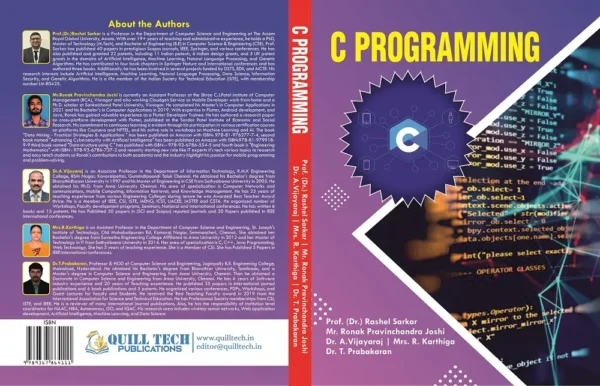
The book begins by highlighting the significance of the C programming language, tracing its history back to its development in 1972 by Dennis Ritchie at Bell Labs. C’s enduring popularity is attributed to its versatile features such as low-level memory access, high speed, and general-purpose applicability. The book explains how C played a critical role in the development of UNIX and contrasts its evolution from its early days through its modern standards, including ANSI C and C99. These sections emphasize how C has shaped today’s programming landscape and remains fundamental in both system and application software development. Next, the book introduces the basic structure of a C program, explaining the importance of maintaining a clear and logical flow in writing code. It discusses the various sections that make up a C program, such as documentation, preprocessor, definition, global declarations, the main function, and user-defined functions. Each of these parts is explained with examples, illustrating their purpose and how they contribute to the overall execution of a program. By understanding this structure, programmers are able to write more organized and error-free code. The process of executing a C program is thoroughly examined in the following chapters. The book walks readers through the steps involved, from preprocessing and compiling to assembling, linking, and loading the program. These stages are explained in detail to provide an understanding of how C code transitions from written instructions into executable machine code, a critical aspect of programming that often goes unnoticed by beginners. The book continues by covering constants, variables, and data types in C, essential components for managing data in a program. It explains how to define and use constants, including integer, floating-point, character, and string constants, and explores the various data types available in C, such as basic types (int, char, float, double) and derived types like arrays, pointers, and structures. The proper use of these data types is crucial for ensuring efficient memory use and program performance, making this chapter fundamental for beginners. Input and output operations are another essential aspect of C programming. The book explains how to handle user input using functions like getchar() and scanf(), and output using putchar() and printf(). Special attention is given to formatted input and output, showing how to control the display of data using format specifiers, which helps users control the flow of information in their programs. Operators and expressions form a critical part of the book, with an in-depth explanation of how to perform calculations and comparisons in C. Arithmetic, relational, logical, and assignment operators are all covered in detail, with numerous examples illustrating how these operators are used in expressions to evaluate conditions, perform computations, and manipulate data. Understanding these operators is essential for any C programmer, as they form the building blocks of logic in programming. Functions are explored next, highlighting their importance in modular programming. The book explains how to define and call functions, discussing parameters, return types, and the concept of local and global variables. The scope of variables in different functions is also addressed, helping readers understand how data can be shared or isolated within a program to maintain structure and prevent errors. Advanced features of C, including pointers, structures, and unions, are then introduced. Pointers are explained as variables that store memory addresses, allowing direct manipulation of memory. Structures and unions are discussed as ways to group related variables under a single name, providing the flexibility to create more complex data types. These topics are key to understanding dynamic memory management and handling sophisticated data structures in C. Finally, the book concludes with a focus on error handling and debugging in C. It explains methods for detecting and managing errors in programs and provides practical techniques for debugging. This section is essential for ensuring that programs are robust, reliable, and capable of handling unexpected situations gracefully. The tools and strategies discussed here will help programmers troubleshoot issues and refine their code for optimal performance.
C Programming
Get more info
Authors: Prof.(Dr.) Rashel Sarkar, Mr. Ronak Pravinchandra Joshi, Dr. A. Vijayaraj, Mrs. R. Karthiga, Dr. T. Prabakaran
ISBN: 978-93-6786-411-1
Published Date: March,2025
Edition: First
Language: English