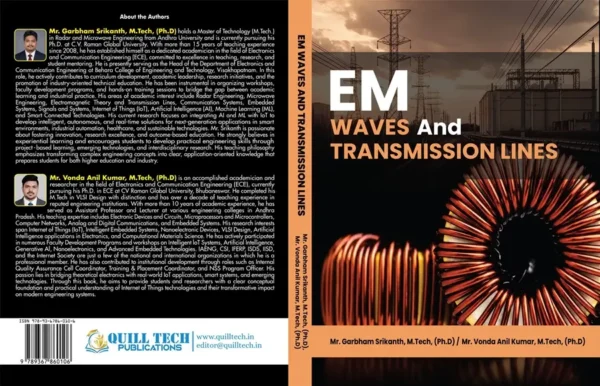
EM Waves and Transmission Lines is a comprehensive engineering textbook that presents the fundamental principles of electromagnetic theory, electric and magnetic fields, wave propagation, and transmission-line analysis. The book begins with coordinate systems and electrostatics, covering Coulomb’s law, electric field intensity, electric flux density, Gauss’s law, electric potential, Maxwell’s equations, electrostatic energy, dielectric polarization, Poisson’s equation, Laplace’s equation, and capacitance. It explores magnetostatics and time-varying electromagnetic fields, including the Biot–Savart law, Ampere’s circuital law, magnetic flux density, magnetic potentials, magnetic forces, Faraday’s law, and displacement current. The discussion further explains Maxwell’s equations and their role in understanding electromagnetic field behaviour and wave propagation. Readers gain a clear understanding of electromagnetic wave characteristics, wave equations, uniform plane waves, sinusoidal variations, and propagation through conducting and dielectric media. The book also examines polarization, reflection, and refraction of plane electromagnetic waves, providing essential knowledge for communication engineering applications. Detailed coverage of transmission-line theory introduces distributed parameters, equivalent circuits, transmission-line equations, primary and secondary constants, characteristic impedance, and propagation constants. Phase velocity, group velocity, infinite transmission lines, lossless transmission lines, and distortionless transmission lines are explained to develop strong analytical foundations. Advanced topics include input impedance, reflection coefficient, voltage standing wave ratio (VSWR), average power, and the behaviour of short-circuited, open-circuited, and matched transmission lines. The book also discusses low-loss radio-frequency and ultra-high-frequency transmission lines, Smith chart construction and applications, quarter-wave transformers, and single-stub impedance matching. Mathematical derivations, solved numerical problems, equations, and labelled illustrations support conceptual understanding and problem-solving skills. The systematic presentation helps students connect electromagnetic field theory with practical transmission and communication systems.
About the Authors’
Mr. Garbham Srikanth, M.Tech, (Ph.D) holds a Master of Technology (M.Tech.) in Radar and Microwave Engineering from Andhra University and is currently pursuing his Ph.D. at C.V. Raman Global University. With more than 15 years of teaching experience since 2008, he has established himself as a dedicated academician in the field of Electronics and Communication Engineering (ECE), committed to excellence in teaching, research, and student mentoring. He is presently serving as the Head of the Department of Electronics and Communication Engineering at Behara College of Engineering and Technology, Visakhapatnam. In this role, he actively contributes to curriculum development, academic leadership, research initiatives, and the promotion of industry-oriented technical education. He has been instrumental in organizing workshops, faculty development programs, and hands-on training sessions to bridge the gap between academic learning and industrial practice. His areas of academic interest include Radar Engineering, Microwave Engineering, Electromagnetic Theory and Transmission Lines, Communication Systems, Embedded Systems, Signals and Systems, Internet of Things (IoT), Artificial Intelligence (AI), Machine Learning (ML), and Smart Connected Technologies. His current research focuses on integrating AI and ML with IoT to develop intelligent, autonomous, and real-time solutions for next-generation applications in smart environments, industrial automation, healthcare, and sustainable technologies. Mr. Srikanth is passionate about fostering innovation, research excellence, and outcome-based education. He strongly believes in experiential learning and encourages students to develop practical engineering skills through project-based learning, emerging technologies, and interdisciplinary research. His teaching philosophy emphasizes transforming complex engineering concepts into clear, application-oriented knowledge that prepares students for both higher education and industry.
Mr. Vonda Anil Kumar, M.Tech, (Ph.D) is an accomplished academician and researcher in the field of Electronics and Communication Engineering (ECE), currently pursuing his Ph.D. in ECE at CV Raman Global University, Bhubaneswar. He completed his M.Tech in VLSI Design with distinction and has over a decade of teaching experience in reputed engineering institutions. With more than 10 years of academic experience, he has served as Assistant Professor and Lecturer at various engineering colleges in Andhra Pradesh. His teaching expertise includes Electronic Devices and Circuits, Microprocessors and Microcontrollers, Computer Networks, Analog and Digital Communications, and Embedded Systems. His research interests span Internet of Things (IoT), Intelligent Embedded Systems, Nanoelectronic Devices, VLSI Design, Artificial Intelligence applications in Electronics, and Computational Materials Science. He has actively participated in numerous Faculty Development Programs and workshops on Intelligent loT Systems, Artificial Intelligence, Generative Al, Nanoelectronics, and Advanced Embedded Technologies. IAENG, CSI, IFERP, ISDS, IISD, and the Internet Society are just a few of the national and international organizations in which he is a professional member. He has also contributed to institutional development through roles such as Internal Quality Assurance Cell Coordinator, Training & Placement Coordinator, and NSS Program Officer. His passion lies in bridging theoretical electronics with real-world IoT applications, smart systems, and emerging technologies. Through this book, he aims to provide students and researchers with a clear conceptual foundation and practical understanding of Internet of Things technologies and their transformative impact on modern engineering systems.