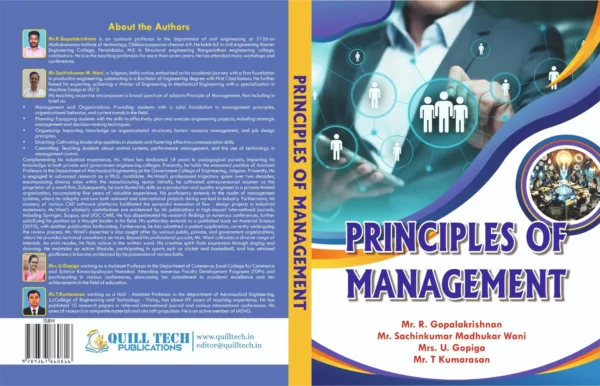
The book “Principles of Management” provides a comprehensive exploration of key management concepts, theories, and applications that are fundamental to organizational success. It begins with an introduction to management and organizations, covering the definitions, nature, and scope of management, as well as its role in economic development and business operations. The book discusses the functions of management, including planning, organizing, leading, and controlling, which serve as the foundation for effective managerial decision-making and strategic execution. It also elaborates on different levels of management, from top executives to frontline supervisors, and the necessary managerial skills such as technical, human, and conceptual competencies. The text delves into the evolution of management theories, presenting classical approaches like Taylor’s Scientific Management and Fayol’s Administrative Theory, along with behavioral, quantitative, and modern management perspectives. It further examines entrepreneurship, emphasizing the characteristics, functions, and challenges of entrepreneurs in driving innovation and economic growth. The book also provides insights into business organization types, including sole proprietorships, partnerships, joint-stock companies, cooperatives, and public sector enterprises, helping readers understand the diverse structures of business entities. The planning section covers business strategy development, forecasting, decision-making processes, and various planning tools, while the organizing segment highlights organizational structure, departmentalization, authority delegation, and human resource management. The book extensively discusses leadership and motivation theories, exploring their impact on employee performance and organizational effectiveness. Communication, as a crucial managerial function, is analyzed with its different forms, barriers, and strategies for enhancing workplace interactions. The controlling function is explored through techniques like budgetary control, IT-based management control systems, and productivity management. Special focus is given to the system approach to management, emphasizing how organizations function as open systems interacting with their environments. The book also covers current trends in management, such as digital transformation, globalization, and ethical leadership. With a structured approach and practical insights, this book serves as an essential resource for students, educators, and professionals in understanding the principles that govern successful management practices. It provides real-world applications and case studies, ensuring that readers gain both theoretical knowledge and practical expertise in handling managerial challenges. Whether for academic learning or professional development, “Principles of Management” offers a solid foundation for mastering the art and science of management in today’s dynamic business world.
Principles of Management
Get more info
Authors: Mr. R. Gopalakrishnan, Mr. Sachinkumar Madhukar Wani, Mrs. U. Gopiga, Mr.T Kumarasan
ISBN: 978-93-6786-081-6
Published Date: February,2025
Edition: First
Language: English