

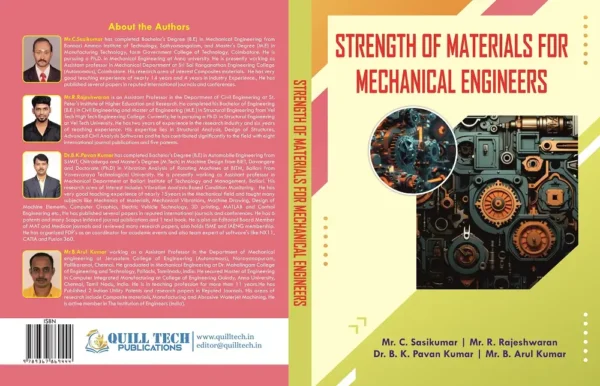
“Strength of Materials for Mechanical Engineers” is a fundamental resource for students, engineers, and professionals in mechanical, civil, and structural engineering. The book provides a thorough understanding of stress, strain, and material behavior under different loading conditions. The introductory chapters discuss the basic concepts of mechanics, including force, equilibrium, and the mechanical properties of materials. It establishes a strong foundation by explaining elasticity, plasticity, and deformation characteristics. Stress and strain analysis is covered in detail, with discussions on axial loading, shear stress, and thermal stresses. The book provides mathematical formulations and problem-solving techniques to help readers analyze material behavior. The section on bending and shear force introduces beam theory, explaining bending moment, shear force diagrams, and stress distribution in beams. Practical applications in structural design are included. Torsion is examined through the study of circular shafts and helical springs. The book explains torsional deformation, shear stress in shafts, and energy methods in torsion. Deflection of beams is analyzed using various methods, such as double integration, moment-area, and conjugate beam methods. The book provides step-by-step examples for calculating deflections in structural elements. Columns and struts are explored in-depth, covering concepts of buckling, Euler’s formula, and empirical methods. The behavior of long and short columns under axial loads is explained with practical applications. Energy methods and strain energy concepts are introduced, providing insights into work and energy principles in material deformation. Applications in impact loading and resilience are included. Failure theories and criteria for materials are discussed, including maximum stress theory, distortion energy theory, and Mohr’s theory. The book explains how different materials fail under various loading conditions. Thin and thick cylinders are analyzed to determine stresses in pressure vessels. The book covers hoop and longitudinal stresses, essential for designing safe pressure vessels. The book includes discussions on composite materials, analyzing their strength and applications in modern engineering structures. It introduces the mechanics of layered composites and their advantages. Advanced topics such as fatigue, creep, and fracture mechanics are covered to provide a deeper understanding of long-term material behavior under cyclic and extreme conditions. Real-world engineering applications are highlighted throughout the book, showing the relevance of theoretical concepts in industry, construction, and manufacturing. “Strength of Materials for Mechanical Engineers” is structured to enhance learning with solved examples, practice problems, and case studies. The book is a valuable resource for students preparing for exams and professionals seeking to strengthen their knowledge of material mechanics. This comprehensive guide ensures that readers gain both theoretical knowledge and practical problem-solving skills in strength analysis and structural design.
Strength of Materials for Mechanical Engineers
Get more info
Authors: Mr. C. Sasikumar, Mr. R. Rajeshwaran, Dr. B. K. Pavan Kumar, Mr. B. Arul Kumar
ISBN: 978-93-6786-944-4
Published Date: February,2025
Edition: First
Language: English
Related Books
-
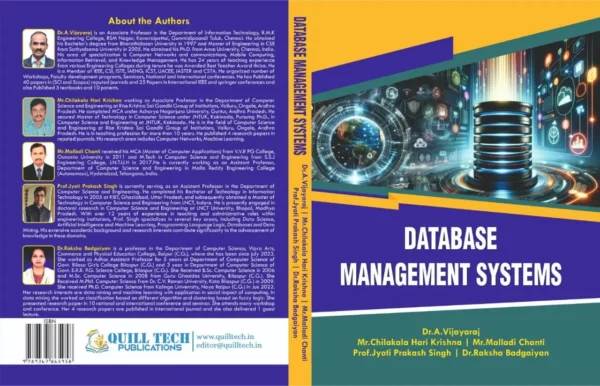
Database Management Systems
-
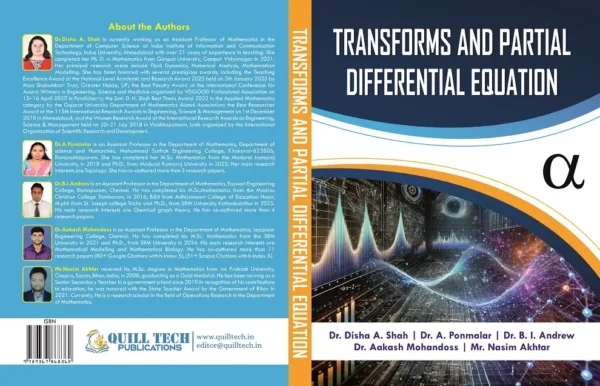
Transforms and Partial Differential Equation
-

Generative AI
-
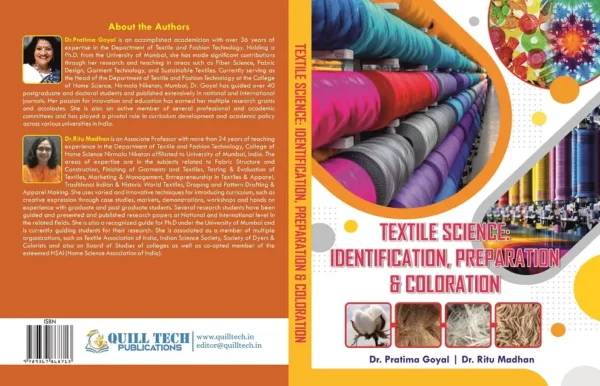
Textile Science: Identification, Preparation & Coloration
-
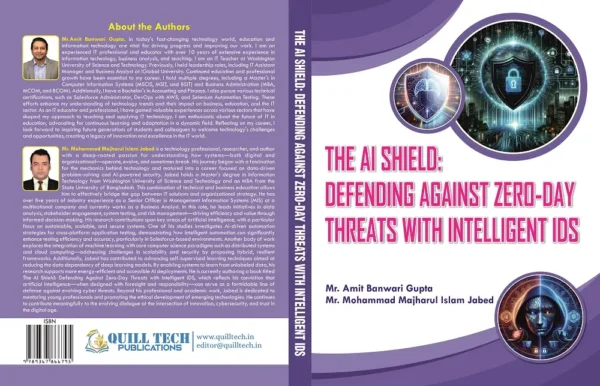
The AI Shield: Defending Against Zero-Day Threats with Intelligent IDS
-
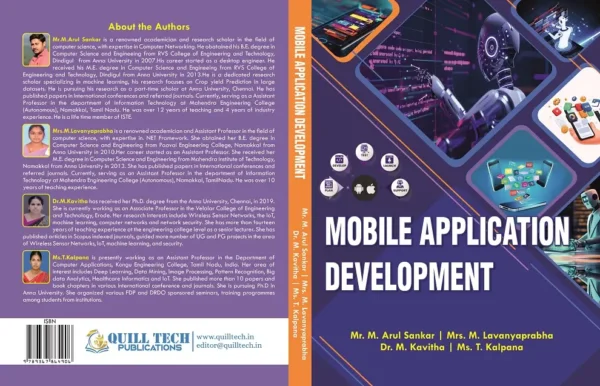
Mobile Application Development
-
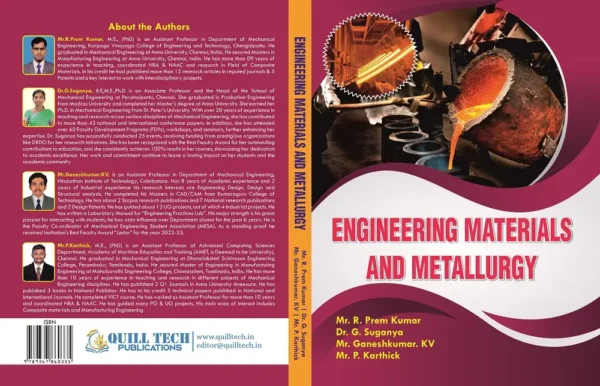
Engineering Materials and Metallurgy
-
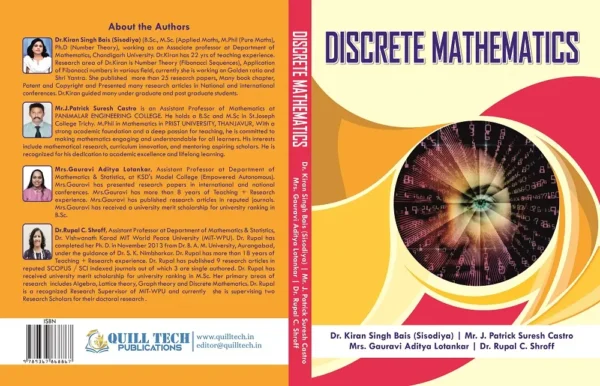
Discrete Mathematics